Former Committee member Jernej Habjan is the guest-editor of a forthcoming issue of CLCWeb titled “World Literature as World Crisis: Discussing World Literature to Change the World.” Aiming to unearth a discourse of crisis in what has been canonized as the debate on world literature, this special issue welcomes contributions that relate the world literature debate to larger issues of world literature as, among other things, a late capitalist commodity, a site of postmodern culture wars, a stand-in for a concept of world history, a bastion of Eurocentrism, a source of anti-Eurocentrism, a project born of internationalist utopianism, and an invitation to a monolingual dystopia. Abstracts of 250 words, including a 100-word bio and 5 keywords, should be sent to jernej.habjan@zrc-sazu.si by March 31, 2025, with full articles of 5,000–8,000 words, or critical reviews of 3,000 words, due by September 30, 2025.
All posts by Host
Publications 2024
Here is a selection of studies published by current and former members of the ICLA Research Committee on Literary Theory in 2024:
Zaal Andronikashvili (ed.), Vom Krieg zerrissene Kulturlandschaften: Nachdenken über die Ukraine. Göttingen: Georg-August-Universität Göttingen;
Natalya Bekhta, “A Re-Invention of Language: War, National Community and a Poetics of the First-Person Plural,” in The Aesthetics of Collective Agency, ed. Simone Knewitz & Stefanie Mueller (Bielefeld: transcript Verlag), 193–212;
Natalya Bekhta, “Beyond the Novel: Satire in Eastern Europe and Volodymyr Rafeyenko’s Mondegreen,” Critique: Studies in Contemporary Fiction 66.1: 12–22;
Rok Benčin, Rethinking the Concept of World: Towards Transcendental Multiplicity (Edinburgh: Edinburgh UP);
Vladimir Biti, “Past Empire(s), Post-Empire(s), and Narratives of Disaster: Joseph Roth’s The Radetzky March and Ivo Andrić’s The Bridge over the Drina,” in The Languages of World Literature, ed. Achim Hölter (Berlin: De Gruyter), 65–84;
Marco Caracciolo, “Metaphorical Figures for Moral Complexity,” New Literary History 55.1: 125–43;
Michel Chaouli, Something Speaks to Me: Where Criticism Begins (Chicago: The U of Chicago P);
Anne Duprat (co-edited w. Alison James), Figures of Chance II: Chance in Theory and Practice, trans. Martyn Beck (London: Routledge);
Divya Dwivedi, “The Psychomachia of Caste and Psychoanalysis in India,” CASTE 5.2: 97–120;
Angela Esterhammer, “The March of Mind: Knowledge Mobilization in the 1820s,” European Romantic Review 35.2: 399–416;
Alexandre Gefen, Repair the World: French Literature in the Twenty-First Century (Berlin: De Gruyter);
Davide Giuriato, “Die Armut (er-)zählen: Bettine von Arnim und die Poetik der Armenliste,” in Armut und Menge, ed. Jobst Welge & Cornelia Wild (Leiden: Brill), 93–109;
Djelal Kadir, “Telemachos Kanthos, the Optometrist of History,”
in Exhibition Catalogue, Kanthos: The Sharp Edges of History. A. G.
Leventis Foundation Gallery, Nicosia, Cyprus (23/11/2024—09/03/2025);
Woosung Kang (co-ed. w. Yu-lin Lee), Current Comparative Literary Studies in East Asia (= Concentric 50.2);
Maya Kesrouany, “Between Writer and Militant: Arab Realism and the Accidental,” Neohelicon 51.1: 85–103;
Ulrike Kistner, “Traumatic Neuroses and Psychoneuroses in (and) Beyond the Pleasure Principle,” in Towards the Limits of Freudian Thinking: Critical Edition and Readings of Beyond the Pleasure Principle, ed. Herman Westerink, Jenny Willner & Philippe Van Haute (Leuven: Leuven UP), 197–223;
Karin Kukkonen, “Designing an Expert-Setting for Interdisciplinary Dialogue: Literary Texts as Boundary Objects,” Social Epistemology 38.1: 38–48;
Svend Erik Larsen, Between Truth and Trust: Forgiveness as a Literary and Cultural Challenge (Cambridge: Ethics P);
Xiaofan Amy Li, “Translation as Queer Practice: (De)gendering Feminist Language in the Poetry of Xi Xi and Zhai Yongming,” in Inclusion, Diversity and Innovation in Translation Education, ed. Alejandro Bolaños García-Escribano & Mazal Oaknín (London: UCL P), 157–76;
Ivana Perica (co-ed. w. Benjamin Kohlmann), The Political Uses of Literature: Global Perspectives and Theoretical Approaches, 1920–2020 (London: Bloomsbury);
Tiphaine Samoyault, “La traduction durable,” Littérature 216: 41–54;
Robert Stockhammer (co-ed. w. Bernd Stiegler & Johannes Ullmaier), Brian Eno (= AugenBlick 90–91);
Susanne Strätling, “Literary Theory between Contingency and Contiguity: Yakov Druskin’s ʽLaw of Heterogeneity’,” Neohelicon 51.1: 19–31;
Ábel Tamás, “Maius opus moveo: Vergil’s Hidden Signature in Aeneid 7.45?”, Classical Philology 119.3: 429–34;
Galin Tihanov, “Desynonymizing (World) Theory and Poetics,” Philosophy and Literature 48.1: 31–47;
Elisabeth Weber, “ʽWhat We Are to Remember in the Future’: Thoughts on Elliot Wolfson’s Book on Dreams,” in New Paths in Jewish and Religious Studies: Essays in Honor of Professor Elliot R. Wolfson, ed. Glenn Dynner, Susannah Heschel & Shaul Magid (West Lafayette, IN: Purdue UP), 31–40;
Stefan Willer, “Contingencies of Localization in Literary Theory,” Neohelicon 51.1: 78–84;
Robert J. C. Young, “Winging It with Wittgenstein and Benjamin,” Neohelicon 51.1: 33–56;
John Zilcosky, “The End of Drawing: Kafka, Jugendstil, and Losing Weight in All Directions,” The Germanic Review 99.2: 144–71.
Annual Workshop: Programme
Zurich, January 31 – February 1, 2025
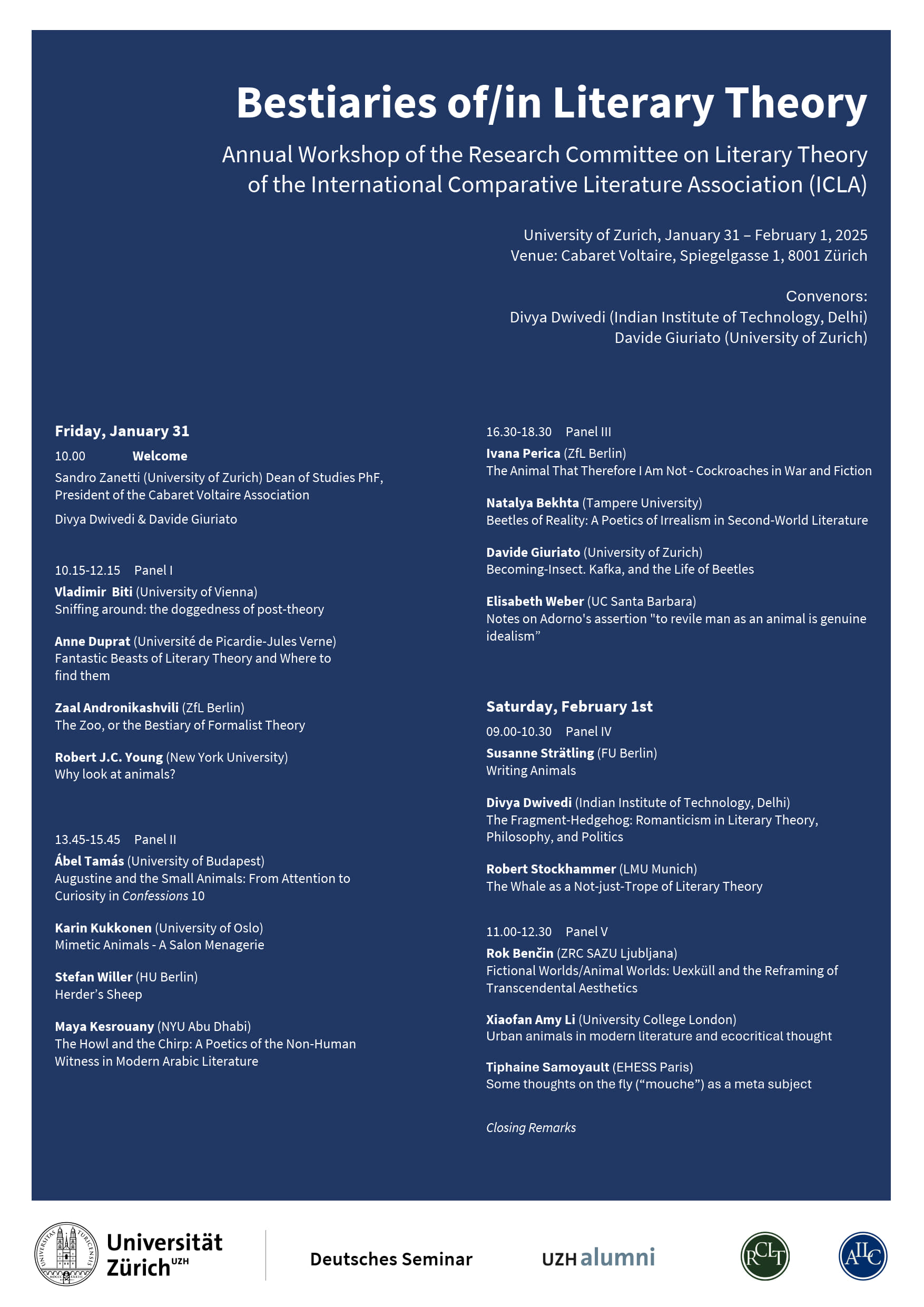
Hosted by the University of Zurich and organised by Divya Dwivedi and Davide Giuriato, this year’s workshop programme includes contributions from Vladimir Biti (Vienna), Anne Duprat (Amiens), Zaal Andronikashvili (Berlin, Tbilisi), Robert J.C. Young (New York), Ábel Tamás (Budapest), Karin Kukkonen (Oslo), Stefan Willer (Berlin), Maya Kesrouany (Abu Dhabi), Ivana Perica (Berlin), Natalya Bekhta (Tampere), Davide Giuriato (Zurich), Elisabeth Weber (Santa Barbara), Susanne Strätling (Berlin), Divya Dwivedi (New Delhi), Robert Stockhammer (Munich), Rok Benčin (Ljubljana), Xiaofan Amy Li (London) and Tiphaine Samoyault (Paris).
Caracciolo: On Soulsring Worlds
Marco Caracciolo, member of the ICLA theory committee, has written the book On Soulsring Worlds: Narrative Complexity, Digital Communities, and Interpretation in Dark Souls and Elden Ring. Published by Routledge, this is the first book-length study of FromSoftware games. Arguing that the games are strategically positioned in relation to contemporary audiences and designed to tap into the new digital forms of interpretation, Caracciolo studies the games in the contexts of the posthuman condition and the ethics of gameplay.
Larsen: Between Truth and Trust
Svend Erik Larsen, former member of the ICLA Research Committee on Literary Theory, has authored the book Between Truth and Trust: Forgiveness as a Literary and Cultural Challenge. Published by Ethics Press, the book approaches forgiveness as a speech act based on a precarious mutual acceptance between victims and perpetrators. Literature, as a creative and imaginary medium of expression, is integrated throughout the book as a vehicle of exploring a deeper understanding of the cultural practice of forgiveness. The book draws on literary texts from different cultures and religions across the globe; from antiquity and early Christianity to the present.
Annual Workshop: Bestiaries of/in Literary Theory
Zurich, January 31 – February 1, 2025
This year’s workshop of the Research Committee on Literary Theory of the International Comparative Literature Association will take place in Zurich at the end of January 2025. Co-organised by Divya Dwiwedi (Indian Institute of Technology, Delhi) and Davide Giuriato (Universität Zürich), the workshop will focus on the topic of animals, animal tropes and bestiaries – as lists, concepts, classifications – of literary theory. The workshop venue is the historic “Cabaret Voltaire”.
Programme TBA
Anastasis: Philosophy, Politics, Revolution
Divya Dwivedi in conversation with Matti Kangaskoski, 9 October, Helsinki
In this coversation, organised by the current committee member Natalya Bekhta in co-operation with Tekstin talo, philosopher Divya Dwivedi and writer Matti Kangaskoski will discuss the idea of anastasis. The conversation will take place at Tekstin talo in Helsinki (Finland), 14-16:00, 9 October 2024.
Ana-stasis in its secular sense means: coming over stasis. It is the rising up from the impasse of politics, which comprehends the whole world in its grip today – through global financial institutions and regimes of technology that sustain structural inequality, unemployment, disease, homelessness, and misery. Philosophy must name the laws that comprehend this stasis. Politics must be the fight for freedom for all people without exception. Then revolution would not remain the melancholic name of past events that appear “failed” in the rear view mirror of post-world-war world order, nor the name of counter-movements of identity without teleographs. Then revolution would be the fight to change the comprehending laws rather than merely resist the componential laws of countries, localities, sectors. Revolution would be: Ana-stasis.
The event is sponsored by Tekstin talo and the Research Council of Finland (via the research project “Utopia and Eastern European Literature after 1989“).
Symposium “Utopian Openings and Decolonial Futures”, 7 October, Tampere
Committee members Divya Dwivedi and Ivana Perica will take part in the symposium on “Utopian Openings and Decolonial Futures“, organised by Natalya Bekhta (current committee member) and Mikko Joronen at Tampere University (Finland), 7 October.
This half-day symposium, within the framework of the Tampere Institute for Advanced Study, will discuss the conditions of anti-imperialist and liberatory decolonial practices today – conditions that have often been seen to enable, rather than hinder, emancipatory intellectual solidarities. Divya Dwivedi will take on the theoretical status quo in post- and decolonial theory today from an angle rarely discussed in the European context: That of the 3000-year long oppression of the majority of population in India by the Hindu minority via the caste system. In a series of responses and a conversation, following her talk, we will focus on the question of how exactly we, as scholars, can properly engage with multiplicity of politicisations and spatialisations of the decolonial? What sites of everyday violence and spatialized power relations decolonization inhabits when travelling from one site to another? Against all the promises of liberation, utopia and recovery, is there a negative work of the decolonial? How do we find in the present the language suitable for discussing a better future?
Programme:
Lecture:
Divya Dwivedi: “Provincializing Decoloniality”
Responses:
Ivana Perica (Berlin), Research Fellow, Leibniz-Zentrum für Literatur- und Kulturforschung (ZfL)
Wassim Ghantous (Tampere), Postdoctoral Research Fellow, Regional Studies, Palestine Research Group/Space and Political Agency Research Group
Natalya Bekhta (Tampere), Academy Research Fellow, Narrare: Centre for Interdisciplinary Narrative Studies
Mikko Joronen (Tampere), Associate Professor, Regional Studies, Palestine Research Group/Space and Political Agency Research Group
Further details and location HERE.
CFP: The Political Novel in Europe and the Challenges of the Digital Era
Workshop, 16–17 January 2025, Leibniz-Center for Literary and Cultural Research Berlin (ZfL)
This workshop is part of the European Union-sponsored Horizon Europe-project “The Cartography of the Political Novel in Europe”, involving current Committee member Ivana Perica. Organised by the ZfL in cooperation with the University of Nicosia, it will take place in Berlin as a hybrid event.
The workshop organisers seek short input presentations (10 min max) based on pre-circulated papers that engage with the proposed topic through theoretical or methodological considerations, analyses of novels, or studies of literary fields. Each presentation will be followed by a response to leave plenty of room for discussion.
Please check the full CfP for details HERE.
Deadline for abstracts: September 15th 2024; full papers are expected before December 10th 2024.
Duprat (co-ed.): Figures of Chance II: Chance in Theory and Practice
Anne Duprat, member of the ICLA theory committee, and Alison James have co-edited the collective volume Figures of Chance II: Chance in Theory and Practice (Routledge). The companion volume to Figures of Chance I: Chance in Literature and the Arts (16th–21st Centuries), the book proposes a multidisciplinary analysis of cultural phenomena related to notions of chance and contingency. Partly building on the Committee’s 2021 annual workshop “Théories littéraires du hasard et de la contingence / Theorizing Chance: How Does Literary Theory Deal with Contingency?”, it reevaluates the role played by figurative representations of chance in contemporary discourses about chance and contingency.
 ICLA theory